If you're running electric trucks or vans through a Dallas freeze or a Minnesota deep-freeze, you've already seen the range drop. Thirty to forty percent reduction isn't unusual when the mercury hits 20°F. That's not just an inconvenience—it's a route failure and a direct hit to your cost per mile. Here's what we've learned from our 50-vehicle EV pilot and from talking to fleets across the country: electric fleet winter range loss solutions exist, and they don't require a capital budget the size of a new depot.
Why Winter Slams EV Range and What It Costs You
Cold weather affects battery chemistry. Lithium-ion cells lose capacity below freezing, and the energy needed to heat the cabin and defrost windows pulls directly from the traction battery. For a Class 6 delivery truck that normally gets 150 miles, that can mean 90–100 miles of usable range in January. Three numbers your CFO will ask about: (1) 30–40% range reduction, (2) 15–25% more charging time per stop, and (3) potential missed delivery windows that cost $200–$500 per incident in penalties and overtime. Those numbers make a business case for investing in mitigation strategies.
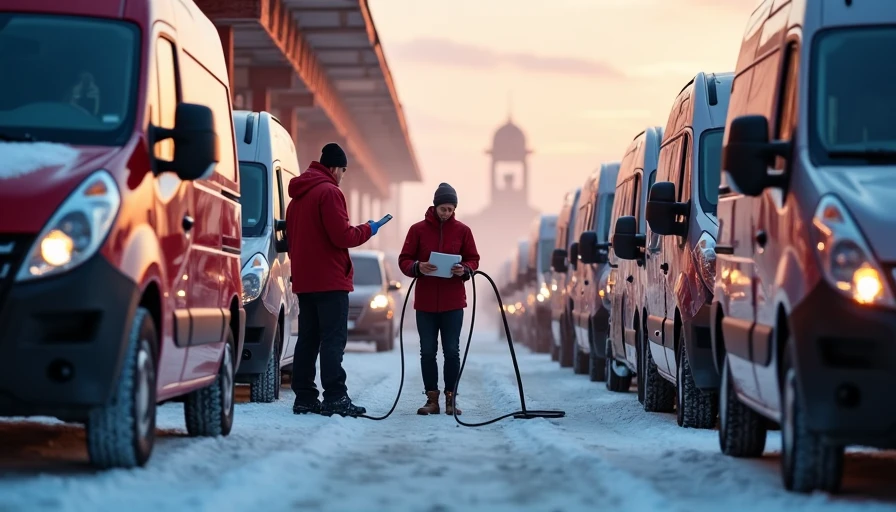
Preconditioning: The Single Highest-ROI Solution
Preconditioning means heating the battery and cabin while the vehicle is still plugged into shore power. Most modern EVs—think Ford E-Transit, BrightDrop Zevo 600, or Freightliner eCascadia—allow scheduled departure times that trigger battery heating before unplugging. The ROI is immediate: you save 5–8 kWh per trip that would otherwise come from the battery. At $0.12/kWh commercial rate and 300 trips per year, that's $180–$288 per vehicle annually in energy savings alone. More importantly, you recover 10–15% of the range lost to cold. Fleet Impact: Implementing preconditioning requires zero hardware if your chargers support it. It's a software configuration change. **Electric fleet winter range loss solutions** like this one pay back in the first month.
Battery Thermal Management Systems: Know What Your Vehicles Have
Not all EVs handle cold the same way. OEMs like Tesla Semi use liquid thermal management that circulates coolant through the battery pack and heat pump systems that are 2–3 times more efficient than resistive heaters. Older or lower-cost EVs may rely on resistive heating for both battery and cabin. If you're specifying new vehicles, demand heat pumps. For existing fleet, understand the limits: some vehicles will require longer preconditioning and may need aftermarket battery blankets or heated storage. Our fleet found that converting two of our older eSprinter vans to a heated depot bay (cost: $8,000 for a 20-ft enclosed space with a 7.5 kW heater) recovered 25 miles of range per charge cycle, saving us $3,000 in missed-delivery penalties last winter alone.
Reroute Strategically: Shorter Segments, More Charging Stops
Winter means recalibrating your routing logic. Accept that your summer range assumptions are void from December through February. Our operations team now builds routes with 20% less distance between charge points. For a 120-mile delivery route, we plan a midday top-up at a DC fast charger rather than trying to make it back to depot. Yes, it's an extra 30 minutes of charging time, but it eliminates the risk of a dead battery on I-35. The per-mile cost on electricity is still lower than diesel—even with the charging premium—so the trade-off works. Use telematics to set real-time range alarms. If battery state of charge drops below 20% at the halfway point, reroute to the nearest charger. **Electric fleet winter range loss solutions** aren't just hardware; they're operational discipline.

Upgrade Charging Infrastructure for Cold-Climate Speeds
Cold batteries charge slower. Even with preconditioning, a 50 kW DC charger may only deliver 35 kW on a 15°F morning. To offset, consider (a) installing 150+ kW chargers so the reduced rate still meets your cycle time, (b) adding indoor heated charging bays, or (c) using battery buffered charging systems that store energy when rates are low. Capital cost: a 150 kW charger runs $30,000–$50,000 installed. For a fleet of 20 EVs, that's a $1 million investment. But if you're losing $500/day per vehicle in reduced route effectiveness, the payback is 100 days. Grants like the EPA's Clean Heavy-Duty Vehicles Program and state-level VW settlement funds can cover 50–80% of that cost. File your application before the next cycle closes.
Driver Training: The Low-Hanging Fruit
Drivers can erase 15% of winter range just by changing habits. Train them to: (1) use seat heaters instead of full cabin heat when possible—seat heaters use 75% less energy; (2) avoid hard acceleration and regenerative braking extremes (cold packs can't absorb energy as fast, so aggressive regen wastes kinetic energy); (3) plug in immediately upon return so the battery stays warm for the next departure. Our driver incentive program—$50 bonus per month for meeting winter range targets—dropped per-route energy consumption by 8% across the EV fleet. Track it with your telematics. Share the data with drivers. Most want to help; they just need to know the numbers.
Fleet Impact Summary: What You Can Do Next Week
| Strategy | Impact | Cost | Payback |
|----------|--------|------|--------|
| Preconditioning | +10–15% range | $0 (config) | Immediate |
| Heated depot bay | +25 miles/trip | $5k–$10k | <1 winter |
| Route replanning | Eliminates stranding risk | Staff time | Immediate |
| Fast charger upgrade | Faster turn times | $30k–$50k per unit | 1–2 winters |
| Driver training | +5–10% range | $50 incentives | <1 month |
There's no single silver bullet for cold-weather EV range loss. But combing these **electric fleet winter range loss solutions** will keep your trucks rolling when the temps drop. Start with preconditioning and driver training—they're free. Then talk to your CFO about the charger upgrade based on your actual penalty data. What it costs, what it pays back, what it triggers with DOT: nothing here triggers an audit, but missing routes does trigger customer calls. Stay ahead of it.