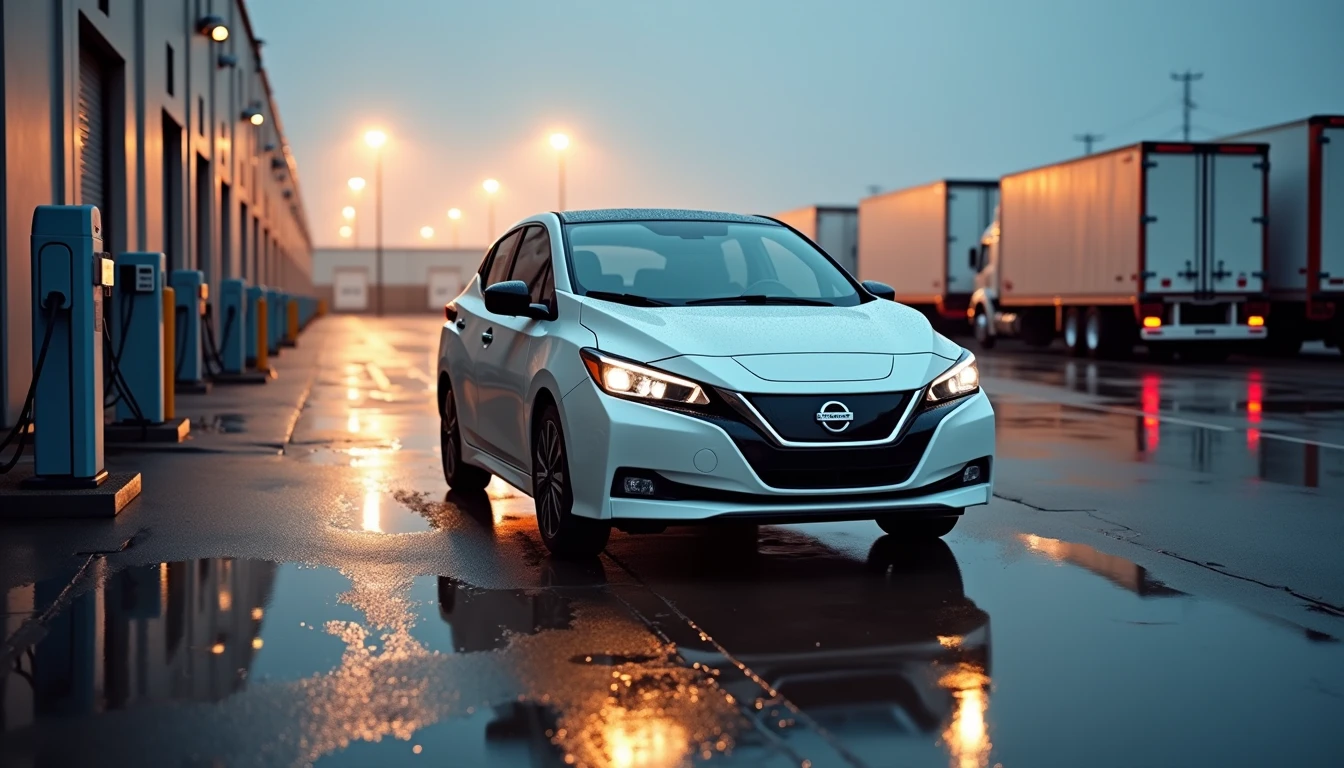
Fleet Electrification: Nissan Outlines a Three-Step EV Adoption Path Centered on Route Fit and Charging Access
The Big Picture (industry context, why this matters now)
Fleet electrification is increasingly a cost-and-uptime conversation, not a branding exercise. Nissan’s fleet electrification guidance frames EV adoption as a practical “start with one” approach—evaluate route duty cycle and charging access first, then scale with the right infrastructure and management tools. For fleet managers, that sequencing matters because it reduces the risk of buying vehicles that don’t match real-world utilization and avoids avoidable downtime tied to charging friction.
Nissan positions switching to an EV fleet as “a sound business strategy,” citing connectivity, safety and driver assist technology, and “easy charging solutions” as the operational enablers. The core message for decision-makers: electrification should be deployed where it fits the work, with operational controls (charging access and driver tools) in place before you add units.
> Fleet Impact (Business Case Gate)
> - ROI/Payout: Not quantified in the source; treat as route- and electricity-rate-dependent.
> - Uptime: Improved only if charging access is planned up front; otherwise downtime shifts from shop to charger.
> - Compliance: “Zero tailpipe emissions” can support internal sustainability targets; regulatory requirements will still depend on your jurisdiction and fleet class.
Key Details (specs, performance, features, comparison)
Nissan’s fleet electrification content revolves around a three-step build plan and a flagship EV option for fleets:
1) Assess fleet needs (route, cargo, charging access)
Nissan’s first step is to “assess your fleet needs to determine if an EV like the Nissan LEAF fits your routes, cargo requirements, and charging access.” That’s the right order of operations. Route length and dwell time (where vehicles sit long enough to charge) are the gating factors, with cargo requirements acting as a practical constraint for what vehicle class can do the job.
2) Plan charging infrastructure (public network access via app)
On charging, Nissan emphasizes app-enabled access to public infrastructure:
- The MyNISSAN app can help drivers “locate public charging stations.”
- Nissan states fleets can “locate and connect to thousands of in-network public chargers for your 2026 LEAF, including compatible Tesla Superchargers,” through the “NISSAN ENERGY Charge Network” using the MyNISSAN app.
For operations, that’s less about convenience and more about reducing failed charge events and driver time lost searching for a charger—two common early-stage electrification pain points.
3) Utilize Nissan EV resources (organizational support)
Nissan highlights three internal support channels for fleet transitions:
- A local Nissan dealer as an “EV expert”
- A commercial sales manager to handle “logistics and details”
- The MyNISSAN app as “the essential app for managing your personalized ecosystem of connected driver experiences”
This is essentially a resourcing plan: who owns vehicle selection, deployment logistics, and day-to-day driver enablement.
Vehicle anchor: 2026 Nissan LEAF (headline capability)
Nissan positions the LEAF as a fleet EV with:
- “Instant acceleration” and “responsive handling”
- “Zero tailpipe emissions”
- EPA-estimated range of up to 303 miles for 2026 LEAF S+ (noted as late availability)
- Feature callouts: aerodynamic design, Zero Gravity seats, and regenerative braking
Range is the one hard spec provided, and it should be treated as a planning input—not a guarantee of achieved route miles—because real-world range varies with duty cycle, speed, HVAC use, payload, and weather (none of which are quantified in the source).
> Fleet Impact (Vehicle Fit Check)
> - Route coverage: Nissan cites up to 303 miles EPA-estimated range for the 2026 LEAF S+ (late availability).
> - Fuel/energy: No kWh/mi or charging-rate data provided in the source, so model energy cost with your utility rate and real duty cycle.
> - Operations: Regenerative braking can reduce brake wear in stop-and-go service, but Nissan does not provide service interval or cost-per-mile data.
Operational Impact (maintenance, TCO, fleet implications)
From an operations manager’s standpoint, Nissan’s guidance translates into a controlled pilot-to-scale method:
Start with one = prove the duty cycle before you standardize
“Start with one” is the lowest-risk way to validate whether EVs can meet dispatch realities. The practical move is to pick a route with predictable daily mileage and reliable dwell time (overnight parking or long stops) so charging doesn’t become a productivity leak.
Charging access is an uptime decision, not a convenience feature
Nissan’s emphasis on the MyNISSAN app and the NISSAN ENERGY Charge Network is really about reducing charging uncertainty. If a driver can reliably locate and connect to “thousands of in-network public chargers,” including “compatible Tesla Superchargers,” you reduce:
- Unplanned detours to find charging
- Queue risk at limited sites (still a factor—Nissan does not quantify availability)
- Dispatch disruption from misplanned charging windows
For mixed fleets, public charging access can be a bridge while you evaluate whether depot charging is required for your operation. The source does not provide depot equipment specs or installation guidance, so treat infrastructure planning as its own project with site power constraints and permitting considerations.
Driver adoption ties back to productivity
Nissan’s focus on “connected driver experiences” signals an operational lever: when drivers can find charging reliably, you reduce calls to dispatch and improve route adherence. That’s not a soft benefit—those minutes add up across a fleet.
Tax savings: treat as a planning variable, not guaranteed ROI
Nissan references “2026 tax savings” and “tax benefits when you purchase a qualifying Nissan vehicle for your business,” positioning EVs as a potential deduction opportunity. The key limitation: the source provides no dollar amounts, eligibility criteria, or timing. Fleet managers should run tax treatment through finance and confirm qualification before counting it in a total cost of ownership model.
> Fleet Impact (Implementation Controls)
> - ROI: Nissan references tax benefits but provides no figures—do not book savings until qualification is confirmed.
> - Downtime risk: Highest early risk is charging friction; mitigate by validating charging access on the actual route.
> - Compliance: Continue to meet DOT/FMCSA requirements applicable to your operation; the source does not claim exemptions.
What to Watch (regulatory, market trends, upcoming changes)
- Range claim timing: Nissan states the 2026 LEAF S+ range (up to 303 miles EPA-estimated) with late availability. If you’re building a procurement calendar, availability timing impacts deployment sequencing and may require interim solutions.
- Charging interoperability: Nissan explicitly mentions access to “compatible Tesla Superchargers” via its network and app. Compatibility and network terms can change; confirm operational access, authentication process, and driver workflow before relying on it for critical routes.
- Emissions positioning vs. requirements: “Zero tailpipe emissions” can support corporate sustainability goals, but it doesn’t replace compliance planning. Regulatory applicability (FMCSA/DOT, state mandates, local idle rules, and any facility requirements) will depend on your fleet type and operating geography—none of which the source details.
Bottom Line (recommended action for fleet/ops managers)
If you’re considering electrification, follow Nissan’s sequencing because it protects uptime: (1) validate route fit and charging access, (2) lock in a charging plan using driver-facing tools like MyNISSAN and your chosen network access, then (3) scale with internal resources and a clear support model. Use the EPA-estimated up to 303-mile range claim for the 2026 LEAF S+ (late availability) as a planning input, but only after you’ve mapped real routes and dwell time so you’re not buying range you can’t operationalize—or worse, deploying units that can’t finish the day.