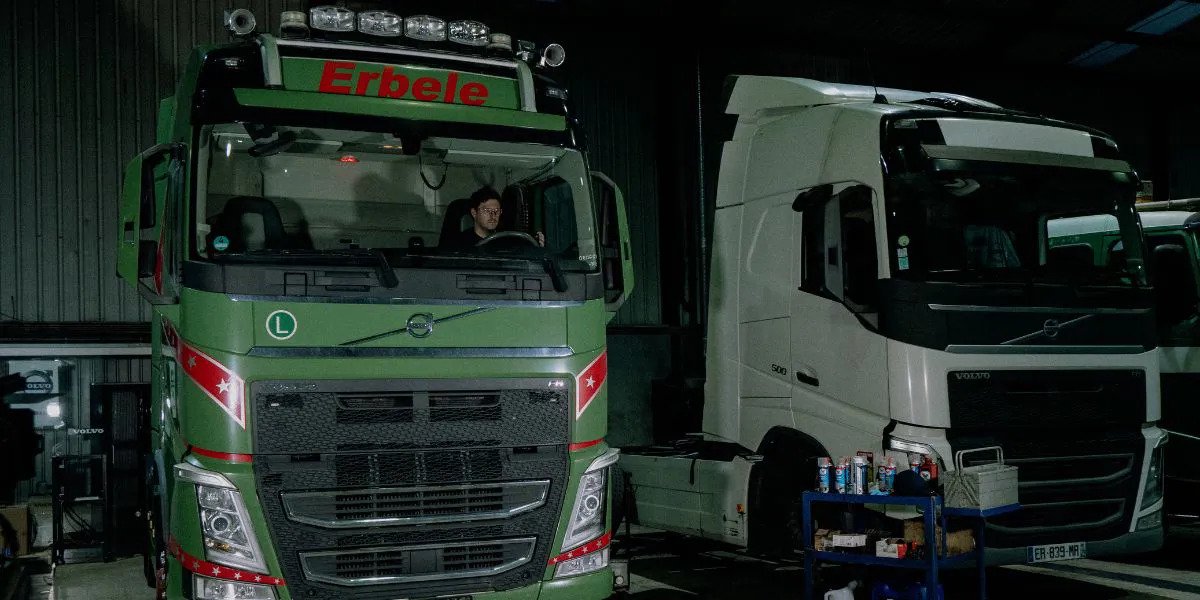
When the European Union passed Euro 7 in 2024, commentary tended to polarize — calling it either the final 'combustion engine regulation' or a trivial refinement of Euro 6. Neither characterization is quite accurate. Euro 7 stands apart as the first regulatory framework to bring cars, vans, lorries, and buses under one unified structure, and its scope extends well beyond what comes out of the exhaust pipe.
For cars and vans (light-duty vehicles), the tailpipe pollutant thresholds stay close to those set by Euro 6. The real shift lies not in the numbers themselves but in how long vehicles must sustain compliance and how that compliance is verified under real driving conditions. For trucks and buses (heavy-duty vehicles), the picture changes considerably: actual limits tighten in meaningful ways, particularly for nitrogen oxides (NOx) and particle numbers, pushing both manufacturers and fleet operators toward more rigorous management of aftertreatment systems.
Euro 7 also ventures into new territory by addressing brake dust and tyre abrasion — the first regulatory framework to cover non-exhaust emissions. For electric and plug-in hybrid vehicles, the regulation introduces minimum battery durability standards, giving fleet buyers and second-hand market participants a guaranteed baseline of performance across the vehicle's service life.
Cars and vans (M1, N1) – New types: from 29 November 2026 – All new vehicles: from 29 November 2027
Lorries and buses (M2, M3, N2, N3, O3, O4 trailers) – New types: from 29 May 2028 – All new vehicles: from 29 May 2029
Small-volume manufacturers – Deadlines extend further, into 2030–2031, depending on category.
Did you know? Euro 7 was officially published as Regulation (EU) 2024/1257 in May 2024. It entered into force just 20 days after publication, though the application dates are spread out to allow manufacturers, fleets, and workshops adequate time to adapt.
Even though Euro 7 may appear to be a technical amendment buried in legislative language, its effects will surface in the routine of everyday fleet operations. The changes can be understood by grouping them into five distinct areas:
Under Euro 6, cars and vans were required to remain within emissions limits for 100,000 kilometres or five years. Euro 7 extends that window considerably. Vehicles must now stay compliant for up to 200,000 kilometres or 10 years, depending on their category. For heavy-duty vehicles, the durability requirements reach even further, effectively spanning the majority of a lorry or bus's working life.
For workshops, this translates into emissions-related components — diesel particulate filters (DPFs), selective catalytic reduction (SCR) systems, sensors, and EGR valves — that must hold up over greater distances without falling out of tolerance. It also raises the stakes for fluid quality. Incorrect oil, coolant, or AdBlue can degrade aftertreatment systems ahead of schedule, generating costly downtime and compliance problems.
Another significant change is the degree to which Euro 7 vehicles will monitor their own condition.
● OBM (On-board Monitoring) requires vehicles to track their own pollutant output — NOx, particles, and for heavy-duty vehicles, ammonia as well. When emissions exceed the legal threshold, that exceedance must be recorded. Some of this information will be made accessible to drivers, while anonymised data can also be transmitted remotely.
● OBFCM (On-board Fuel Consumption Monitoring), already introduced under Euro 6, takes on greater prominence. Fleets will be able to pull long-term fuel or electricity consumption data directly from the vehicle's own systems, enabling operators to compare actual efficiency against projected figures.
For workshops, the capacity to retrieve, interpret, and act on these data logs will matter just as much as traditional diagnostic skills. A Euro 7 vehicle may arrive flagging an 'emissions exceedance' that requires analysis, not simply a warning light reset.
For the first time, Euro 7 brings regulation to pollution that never exits the tailpipe.
● Brake dust: Cars and vans must fall within new particulate mass thresholds, with different limits applying to electric vehicles, hybrids, and large vans.
● Tyre abrasion: Restrictions will be phased in gradually — beginning with passenger car tyres in 2028, extending to vans and light trucks in 2030, and reaching heavy-duty tyres by 2032.
Two consequences follow for fleet operators:
1. Procurement teams will need to evaluate tyre classifications and brake system specifications, not just cost and kilometre ratings.
2. Routine servicing in workshops will need to encompass tyre wear assessment and brake dust mitigation systems.
Euro 7 offers clearer answers to a concern that has long troubled fleet managers: how well will an electric vehicle's battery hold up over time?
The regulation now mandates that passenger cars and vans retain at least:
● 80% of original capacity after 5 years or 100,000 km
● 72% after 8 years or 160,000 km
Manufacturers must also make state-of-health (SoH) data available in a format readable by drivers and fleet operators. For garages, this opens a new service category: battery health assessments, warranty documentation, and advising customers on replacement or resale timing.
The segment facing the most substantial adjustments is heavy-duty. Euro 7's NOx and particulate limits are far more stringent than those under Euro 6, and the test procedures — including real-world driving evaluations — are considerably more demanding.
Trucks and buses will consequently depend on:
● Higher-performance SCR systems with reduced tolerance for substandard AdBlue quality.
● Low-ash lubricants designed to protect aftertreatment hardware.
● Accurate calibration and continuous monitoring of EGR systems, sensors, and filters.
For fleet operators, the risk is straightforward: cutting corners on fluid quality or service intervals can result in logged exceedances, non-compliance findings, and escalating costs.
Quick checklist: Euro 7 readiness signals
● Can your workshop tools read OBM and OBFCM data?
● Do you have sourcing options for low-dust brakes and Euro 7-compliant tyres?
● Is your fluids policy aligned with aftertreatment protection requirements — correct SAPS oils, coolants, and AdBlue?
● Are you equipped to assess and explain battery state-of-health to your customers?
● Have your technicians been briefed on emissions exceedance procedures?
The Euro 7 text is technically dense, but the practical impact becomes more manageable when separated into light-duty (cars and vans) and heavy-duty (lorries, buses, trailers). Each side of the fleet confronts a different set of challenges.
For cars and vans, the most notable observation is that tailpipe limits barely shift from Euro 6. A van fleet operator today may find that the Euro 7 equivalent model looks largely unchanged on the specification sheet. The real differences are embedded beneath the surface:
● Vehicles will be equipped with on-board monitoring that logs emissions whenever they exceed defined thresholds.
● Brake and tyre emissions will gradually become part of procurement decisions. Fleets that routinely select the lowest-cost pads and tyres may find compliance increasingly difficult to sustain.
● Battery health data will become a visible and routine aspect of managing plug-in vans and company cars.
Put simply, Euro 7 light-duty compliance revolves around durability, data, and non-exhaust emissions rather than headline tailpipe numbers. For workshops, this means introducing new diagnostic procedures and stocking parts catalogues with low-dust brake kits and Euro 7-approved tyres.
For lorries and buses, the adjustments are far more tangible.
● Tailpipe standards tighten materially: Euro 7 heavy-duty vehicles must produce lower NOx emissions and fewer particles under both steady-state and transient test cycles.
● Greater weight is placed on real-world operating conditions rather than laboratory test benches. Aftertreatment systems must perform consistently across urban stop-start driving, regional routes, and long-haul operation.
● Durability requirements extend far enough that fleets should expect near-new emissions performance to be maintained across virtually the entire first service life of a truck or bus.
Side by side: light-duty vs heavy-duty
Light-duty (cars/vans)
Heavy-duty (lorries/buses)
Tailpipe pollutant limits
Largely unchanged vs Euro 6
Significantly lower NOx and PN limits
Durability requirement
Up to 200,000 km / 10 years
Extended lifetimes covering full first use
On-board monitoring (OBM)
NOx, particles, and ammonia
Non-exhaust emissions
Brake dust and tyre abrasion limits phased in
Tyre limits phase in later; brake tests later
Applies to BEVs and PHEVs (capacity thresholds)
Not directly, except for future e-trucks
Data-driven servicing, parts selection, EV SoH
Fluid quality, SCR performance, tighter service discipline
For operators, fluid and parts selection become critical decisions. Incorrect AdBlue concentration, a non-approved lubricant, or low-grade sensors can each trigger exceedance events stored in the vehicle's memory. With OBM active, those records will not be erased at the next service reset — they will persist as part of the compliance history.
It is tempting to treat Euro 7 compliance as a challenge that falls exclusively on vehicle manufacturers. They design the powertrains, certify the models, and submit them for type approval. In practice, however, the regulation's extended durability requirements distribute responsibility further down the chain: what enters the vehicle throughout its operational life is as consequential as how it left the production line.
The selection of engine oil, coolant, transmission fluid, brake components, tyres, and AdBlue can determine whether a fleet sails through compliance or accumulates a log of exceedance events.
Contemporary aftertreatment systems — diesel particulate filters (DPFs), selective catalytic reduction (SCR) systems, and petrol particulate filters (GPFs) — are acutely sensitive to ash and sulphated compounds.
● Low- and mid-SAPS oils (sulphated ash, phosphorus, sulphur) are already the accepted standard, but Euro 7's extended durability windows mean that oil selection will now influence compliance outcomes for up to 200,000 km or beyond.
● Using the wrong oil may not produce an immediate failure, but gradual DPF loading or catalyst poisoning can develop over time, eventually producing logged exceedances.
● For mixed fleets, oil policies should be defined by engine family and aftertreatment architecture rather than the convenience of centralized bulk storage.
Valvoline Global offers a range of low-SAPS heavy-duty diesel oils and passenger car engine oils engineered to safeguard DPF and SCR systems, extending the operational life of aftertreatment hardware.
Euro 7's durability focus elevates cooling systems to a compliance concern. A blocked EGR cooler or corroded turbo bearing drives emissions upward. The wrong coolant chemistry can accelerate exactly those failures.
● Organic Acid Technology (OAT) coolants with long-life stability guard against corrosion and scaling — particularly valuable in mixed fleets where unplanned downtime carries high costs.
● In hybrids and electric vehicles, coolants also regulate battery and e-motor temperatures, directly linking coolant quality to the new battery durability requirements.
Substandard coolant is one of the most frequently cited contributors to premature EGR cooler failure — a component with direct bearing on NOx emissions. Under Euro 7, repeated failures of this kind could generate a string of exceedance records.
The Euro 7 transition will carry financial implications. Fleets should anticipate higher acquisition costs as manufacturers pass along expenses tied to advanced aftertreatment systems, expanded sensor arrays, and battery durability improvements. Maintenance budgets may require upward revision as well, given that more sophisticated systems demand specialist fluids, components, and servicing knowledge.
Proactive planning, however, can convert these costs into managed investments. Strategically phasing out ageing vehicles, implementing predictive maintenance schedules, and working with suppliers on fleet-specific service agreements can limit exposure to unplanned downtime. Fluid analysis programmes and training resources offered by Valvoline Global can help fleets prolong component life and reduce the risk of compliance failures.
Budgeting for Euro 7 ultimately comes down to finding the right balance. Near-term costs may increase, but over the medium term, cleaner and better-maintained fleets stand to benefit from improved reliability, fewer emissions-related penalties, and an enhanced reputation for environmental responsibility.
Euro 7 represents more than another incremental step in emissions legislation. It redefines how vehicles are built, maintained, and tracked across their entire service life. For fleet managers, garage operators, and drivers alike, readiness will be what separates those who absorb the disruption from those who capitalize on it.
Practical steps — modernizing maintenance practices, investing in advanced fluid technologies, upskilling staff, and building stronger supplier partnerships — will make the path to compliance considerably smoother. Companies such as Valvoline Global can provide a meaningful technical advantage, with products and services designed to support both performance and durability as the regulatory environment continues to evolve.
The transition ahead carries genuine complexity, but it equally signals movement toward a cleaner, more efficient transport sector. Fleets that act now will be the ones best positioned to succeed as the new standards take hold.