
Diesel maintenance pays off when it prevents a roadside failure without pulling a healthy truck out of service too often. Start with the engine and vehicle manufacturers’ schedules, adjust for actual duty cycle, and track cost per mile alongside downtime and repeat repairs. For DOT purposes, keep inspection and repair records that show what was found, what was fixed, and when.
Three numbers your CFO will ask about are maintenance cost per mile, downtime hours, and the cost of an unscheduled event. Pull those from your own work orders and dispatch records before changing intervals. What it costs, what it pays back, what it triggers with DOT: that is the decision in one sentence.
Build intervals around the work
A mileage-only schedule can miss a truck that idles through long shifts or runs a power takeoff for hours. For diesel maintenance, record engine hours as well as miles, then compare each unit against the applicable manufacturer’s guidance for severe service, idle time, fuel quality, and operating conditions. Calendar limits matter too for low-mileage units.
Group vehicles by engine, application, and duty cycle rather than giving every asset the same interval. A regional delivery truck with frequent stops and a highway tractor accumulating steady miles may need different scheduling even if their odometers match. Check the engine and chassis manuals: one maintenance event may cover requirements from both.
Oil and filter service is the starting point, not the whole plan. Specify the lubricant grade and performance category required for each engine, and verify that the shop is using the correct filter. Track coolant condition, belt and hose condition, air intake restriction, fuel filters, and water separation according to the equipment manufacturer’s instructions.
Fleet Impact: Longer intervals can reduce scheduled shop visits, but one premature failure can erase the savings. Any extension should stay within manufacturer guidance and account for warranty terms. Oil analysis can help identify trends; it is not permission to ignore a service limit.

Protect fuel, air, and cooling systems
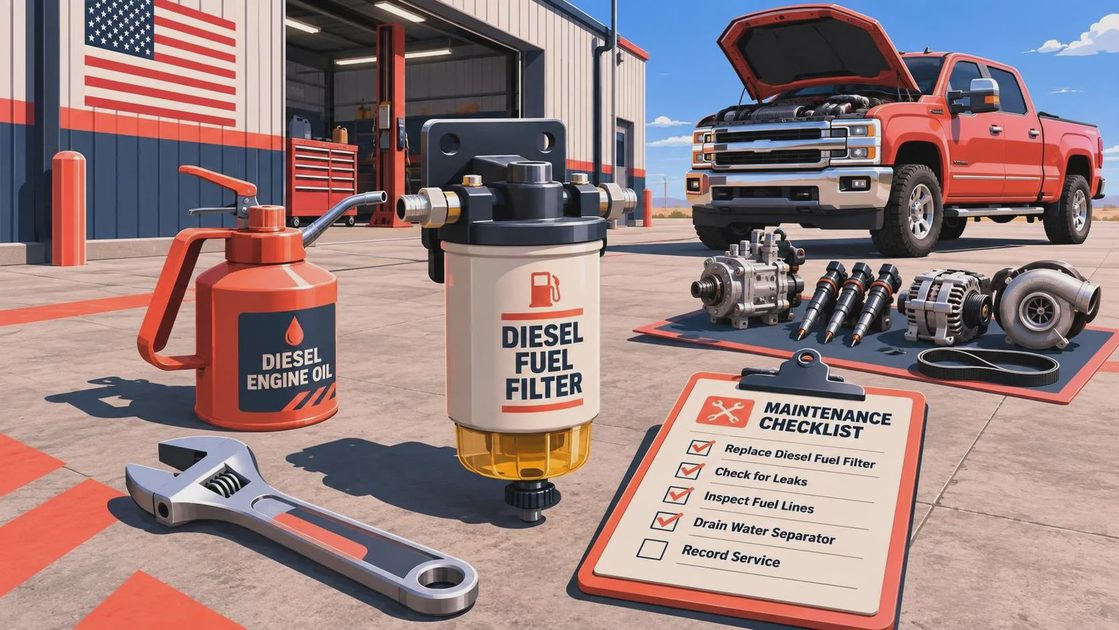
Fuel contamination can turn a small preventive task into an injector or high-pressure system repair. During diesel maintenance, follow the manufacturer’s water-separator inspection and draining procedure, use clean handling practices, and document recurring water or debris. If multiple trucks show the same problem after fueling at one location, investigate the storage or supply chain rather than replacing filters indefinitely.
Air filters need a condition-based approach where the equipment supports it. A restriction indicator can help avoid changing a serviceable element too early, while also flagging a restricted intake. Inspect housings, seals, and ducting for damage or leaks; unfiltered air entering downstream of the element is a different problem from a dirty filter.
Cooling system checks deserve equal attention. Look for leaks, damaged hoses, blocked radiator or charge-air cooler fins, and coolant level or concentration issues. Use the coolant specification and testing method required for that engine. Do not mix products just because their colors look similar. Record repeated top-offs so a slow leak does not disappear into routine servicing.
Manage emissions equipment without shortcuts
Modern diesel maintenance includes the aftertreatment system: exhaust components that control particulate matter and other emissions. Drivers and dispatchers should know which warning lights require prompt shop attention and which operating conditions can interrupt a regeneration. Follow the vehicle manufacturer’s instructions; the appropriate response depends on the equipment and warning.
Repeated regeneration requests, fault codes, rising fuel use, or a loss of power warrant diagnosis, not automatic replacement of an expensive component. The cause may be upstream of the aftertreatment hardware. Preserve fault-code and repair history so a technician can see the pattern instead of starting from zero on every visit.
Keep diesel exhaust fluid clean and in appropriate storage conditions, and prevent it from being added to the fuel tank. Use fluid meeting the vehicle manufacturer’s specification. Tampering with or defeating emissions controls is not a cost-control strategy: the federal Clean Air Act prohibits certain emissions-control tampering and defeat-device activities under 42 U.S.C. § 7522. State requirements can add obligations.
Turn inspection findings into closed repairs
For fleets subject to the Federal Motor Carrier Safety Regulations, 49 CFR § 396.3 requires systematic inspection, repair, and maintenance of vehicles under the motor carrier’s control. It also specifies maintenance records and retention periods for applicable vehicles. Section 396.11 addresses driver vehicle inspection reports and corrective action, with exceptions; section 396.13 requires the driver to review the last report when one is required and sign to acknowledge that required repairs were performed.
Periodic inspections are separate from an oil-service schedule. Under 49 CFR § 396.17, applicable commercial motor vehicles must pass the required inspection at least once every 12 months. Confirm which rules apply to your operation and vehicle types, and check state requirements as well. A preventive maintenance sticker alone does not establish that every required inspection or repair was completed.
For each defect, record the vehicle ID, date, odometer or hours, reported symptom, diagnosis, repair, parts, technician, and return-to-service status. Link roadside calls and repeat complaints to the same asset. Make sure dispatch can see when a vehicle is unavailable; a completed work order entered after the truck leaves is not much help to the person assigning the route.
Fleet Impact: A documented repair trail supports compliance and helps identify repeat failures. The practical risk is not just an inspection finding; it is putting a truck back on the road with an unresolved defect.
Measure the economics before changing the plan
Calculate diesel maintenance cost per mile by dividing the period’s maintenance and repair spend by miles traveled over the same period. Define what goes into the numerator: labor, parts, outside repairs, and roadside charges are useful inclusions. Report fuel, tires, and collision repairs separately if your fleet tracks them elsewhere, and keep the definition consistent across comparisons.
For an illustrative decision, suppose an added inspection costs $40 per truck and is expected to prevent one $2,000 unscheduled event across 100 trucks. The inspection program costs $4,000, so that single avoided event does not cover it. At least two avoided events would be needed to break even on those assumptions, before considering downtime or other effects. Those are example figures, not fleet benchmarks.
Review results by vehicle group, not just fleet average. Track scheduled versus unscheduled shop hours, repeat repairs within a defined window, and roadside events. If an interval change saves shop visits but increases repeat failures or downtime, reverse it. The best schedule is the one your records can defend financially and operationally, while still meeting manufacturer and regulatory requirements.