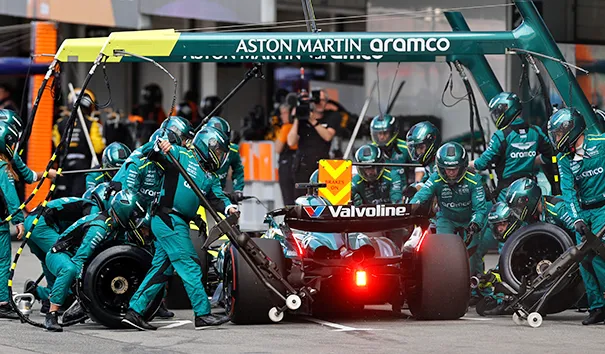
Cutting downtime, managing costs, and keeping vehicles reliably on the road — these pressures define the daily reality of fleet managers, much as race teams obsess over shaving milliseconds from pit stops. The way organisations like Aston Martin Aramco Formula One® Team, proudly supported by Valvoline, function beneath the surface holds genuine lessons for those running everyday fleet operations.
The goal is not to transform your garage into a replica pit lane. Rather, it is about embracing a philosophy where every second carries weight and each team member understands their responsibilities with precision.
A Formula 1 pit stop is executed in under three seconds. Tyres are swapped out, fresh ones fitted, and the car rejoins the race — no hesitation, no wasted motion. The spectacle is remarkable, but the real foundation is relentless repetition and disciplined organisation.
Fleet operators are not racing against a stopwatch, but the underlying principle holds true. When each team member understands the task ahead, knows where the tools are kept, and is clear on their specific role, work moves faster and with less friction — translating directly into reduced downtime and more vehicles back in service.
Establish a prominent central display in your workshop — your equivalent of the F1 pit wall — showing job cards, service intervals, and key performance indicators for the entire team. Keeping this information visible ensures everyone stays aligned and working toward shared objectives.
Every Formula 1 car carries hundreds of sensors capturing live data — from tyre temperature and brake wear through to engine behaviour. That continuous stream of information flows directly to engineers, who base their decisions on evidence rather than intuition.
Fleet operators have comparable tools at their disposal. Telematics systems, oil analysis reports, and digital maintenance logs can expose a vehicle's actual condition well before any breakdown occurs. What separates good fleets from great ones is how that data gets used. Race teams respond immediately to emerging trends — fleets should operate the same way.
A Valvoline oil analysis report, for instance, can detect early indicators of fuel dilution, overheating, or contamination — providing the lead time needed to intervene before an expensive repair becomes unavoidable. This goes beyond routine maintenance; it is about anticipating failures, optimising scheduling, and safeguarding your investment.
Collecting data is only half the equation — acting on it is the other half. Many fleet management systems generate far more reports than teams can realistically process. The answer is to concentrate on three core metrics:
Go over these consistently with your team, the same way a race engineer sits down with their driver to work through lap data after every session.
The remarkable precision of a Formula 1 pit crew stems from each member knowing their exact function — and trusting everyone else to execute theirs. When victory can hinge on tenths of a second, there is simply no space for hesitation or duplication of effort.
Fleet operations perform best under the same framework. Across dispatch, workshop, and driving roles, efficiency depends on open communication and mutual respect. When a technician is uncertain about parts availability, or a driver does not know how to flag a concern, the entire system starts to unravel.
Build processes where information moves in both directions. Give technicians a genuine voice in shaping service schedules. Foster a culture where drivers flag minor issues before they escalate into major ones. Responsibilities should be clearly defined, but collaboration should remain the natural default.
Fleet vehicles may never reach 300 km/h, yet they still contend with intense heat, stop-start stress, towing loads, and extended operational hours. Selecting the right lubricants, coolants, and transmission fluids is not simply about engine protection — it is about protecting your schedule.
Race teams never question the reliability of their tools or fluids — they count on products that deliver without fail, every single time. Fleet operations demand the same standard. When your business depends on uptime, lubricants, coolants, and additives must meet the highest performance thresholds. Valvoline products are proven in some of the most punishing environments motorsport has to offer, and that dedication to quality carries through into every bottle. For fleet operators, that translates to fewer breakdowns, consistent performance, and genuine peace of mind.
You do not need a wind tunnel or a million-pound pit crew to run a high-performing fleet. What you do need is clarity, consistency, and a culture of continuous improvement — the very principles that drive race teams to the front of the grid. And it has to be said, channelling your inner F1 pit crew member makes any working day considerably more exciting!