Fleet insurance belongs in your cost-per-mile calculation, but the premium is only the starting point. A cheaper policy can leave you paying more through deductibles, uncovered vehicles, cargo losses or trucks sitting idle after a crash. Start with three numbers: annual premium, expected retained losses and annual miles. Then check the coverage and filings against the work your vehicles actually do.
What fleet insurance covers
Fleet insurance generally combines commercial auto coverage for multiple vehicles under one program, although the exact structure depends on the insurer and operation. It is not one standardized package. Ask for the declarations, coverage forms, endorsements and exclusions—not just a certificate of insurance.
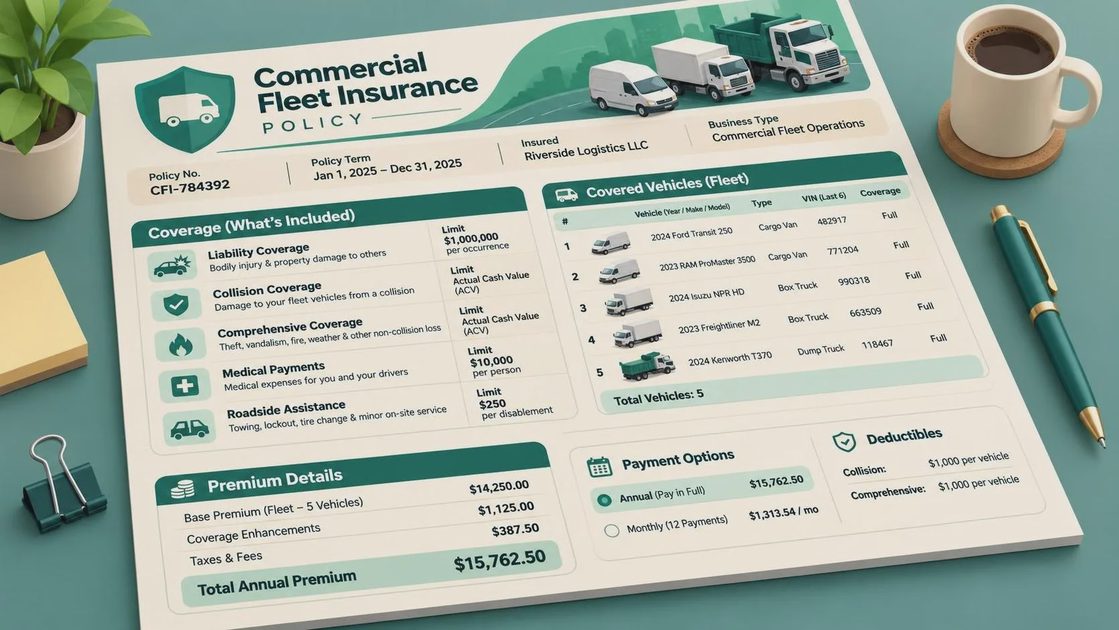
Auto liability addresses covered bodily injury and property damage claims against the insured. Physical damage coverage addresses covered damage to your own vehicles, typically under collision and comprehensive coverage. Neither automatically solves every cargo, equipment or business interruption exposure.
Motor truck cargo coverage, where needed, addresses covered loss or damage to freight subject to its terms. General liability can address certain non-auto business exposures, but the boundary between policies matters. Hired and non-owned auto coverage may be relevant when employees use personal vehicles for work or the company rents vehicles; confirm who is insured and what the policy actually covers.
For a mixed fleet, reconcile the vehicle schedule with your asset register. Include leased equipment, trailers and vehicles temporarily out of service as applicable. Check how newly acquired vehicles are reported, when coverage starts and what happens if a vehicle is omitted. A dispatch system that knows about a truck is not the same thing as an insurer that has accepted it.
Turn the quote into cost per mile
To compare fleet insurance quotes, put every proposal on the same exposure basis: vehicle count and values, operations, radius, drivers, annual mileage, coverage limits and deductibles. A lower quote based on fewer miles or missing trailers is not a savings.
Fleet Impact: As an illustrative calculation, a $400,000 annual premium divided by 4 million annual miles equals 10 cents per mile. Add $80,000 in expected annual retained losses and the combined figure becomes 12 cents per mile. Those are example figures, not a market rate. Use your own loss history and budget assumptions, and separately account for claims-handling fees or other costs not included in the premium.
A higher deductible can reduce premium, but the trade is additional cash exposure. Suppose a higher deductible saves $30,000 a year and increases your retained claim costs by $20,000 in that same year. The illustrative net savings are $10,000, before any administrative costs. One severe claim could change that result. Model several loss scenarios, not just an average year, and confirm whether the deductible applies per vehicle, per occurrence or in another way.
Ask finance how much volatility the company can absorb and whether collateral or claims administration charges apply. A large-deductible program is a financing decision as much as an insurance purchase. Make sure the fleet and finance teams agree on who funds claims and how reserves appear in the budget.
Check DOT requirements before binding
For operations subject to federal motor carrier financial responsibility rules, the required minimum depends on the type of operation, vehicle and commodity. The requirements are not a universal flat amount for every commercial vehicle. Review 49 CFR Part 387 with your broker or counsel, including the applicable provisions for property or passenger carriers, and check state requirements as well.
The MCS-90 endorsement and required federal filings are related but distinct items. An MCS-90 addresses the insurer's obligation for certain public liability judgments under its terms; it is not a substitute for reading the policy or a guarantee that every loss is covered. Where an FMCSA filing is required, confirm that the insurer has made the correct filing and that it is effective. Do not assume a certificate sent by a broker completes that step.
Cargo insurance requirements are also operation-specific. Do not assume that every motor carrier has the same federal cargo filing obligation, or that a shipper's contract matches a regulatory minimum. Verify contractual limits, exclusions and deductibles separately. A customer may require more protection than the law requires.
Fleet Impact: A coverage gap can stop dispatch just as effectively as a parts shortage. Before a renewal, assign one person to verify policy effective dates, filings and customer certificates. Coordinate the handoff so a replacement policy and any required filing are effective before the old coverage ends.
Use loss data to negotiate renewal
Your fleet insurance submission should explain both the exposure and the controls behind it. Request currently valued loss runs for the period your broker and prospective insurers need. Reconcile claim counts, paid amounts, open reserves and vehicle schedules against internal records. A loss run is a snapshot; an open claim can develop after the report date.
Separate preventable collision patterns by route, vehicle type, time of day and damage severity. A cluster of backing incidents calls for a different intervention than highway following-distance crashes. Document completed training, repair procedures and camera or telematics policies, but don't promise an insurer a reduction you cannot substantiate.
Give underwriters context for unusual claims. A single large reserve may reflect a serious unresolved claim, not a predictable annual expense. Provide factual updates and corrective actions without speculating about fault. Ask your claims team and counsel to review sensitive material before it leaves the company.
Protect uptime after a loss
A vehicle can be insured for physical damage while the business still absorbs substantial downtime. Check whether the policy offers rental reimbursement or downtime-related coverage, the waiting period and daily and total limits. A limit that works for a passenger car may not cover a suitable replacement tractor or specialized body.
For EVs and specialized equipment, verify how the policy treats installed equipment, batteries, charging equipment and repair or replacement valuation. Charging infrastructure may belong under a separate property policy rather than auto coverage. Ask about towing, storage and access to qualified repair facilities; don't assume all associated costs fall inside physical damage coverage.
Finally, set a quarterly reconciliation between fleet, risk and accounting. Compare scheduled vehicles with active assets, review open claims and flag changes in routes, commodities or operations to the broker. What it costs, what it pays back, what it triggers with DOT: those answers should be ready before the renewal lands on your desk.