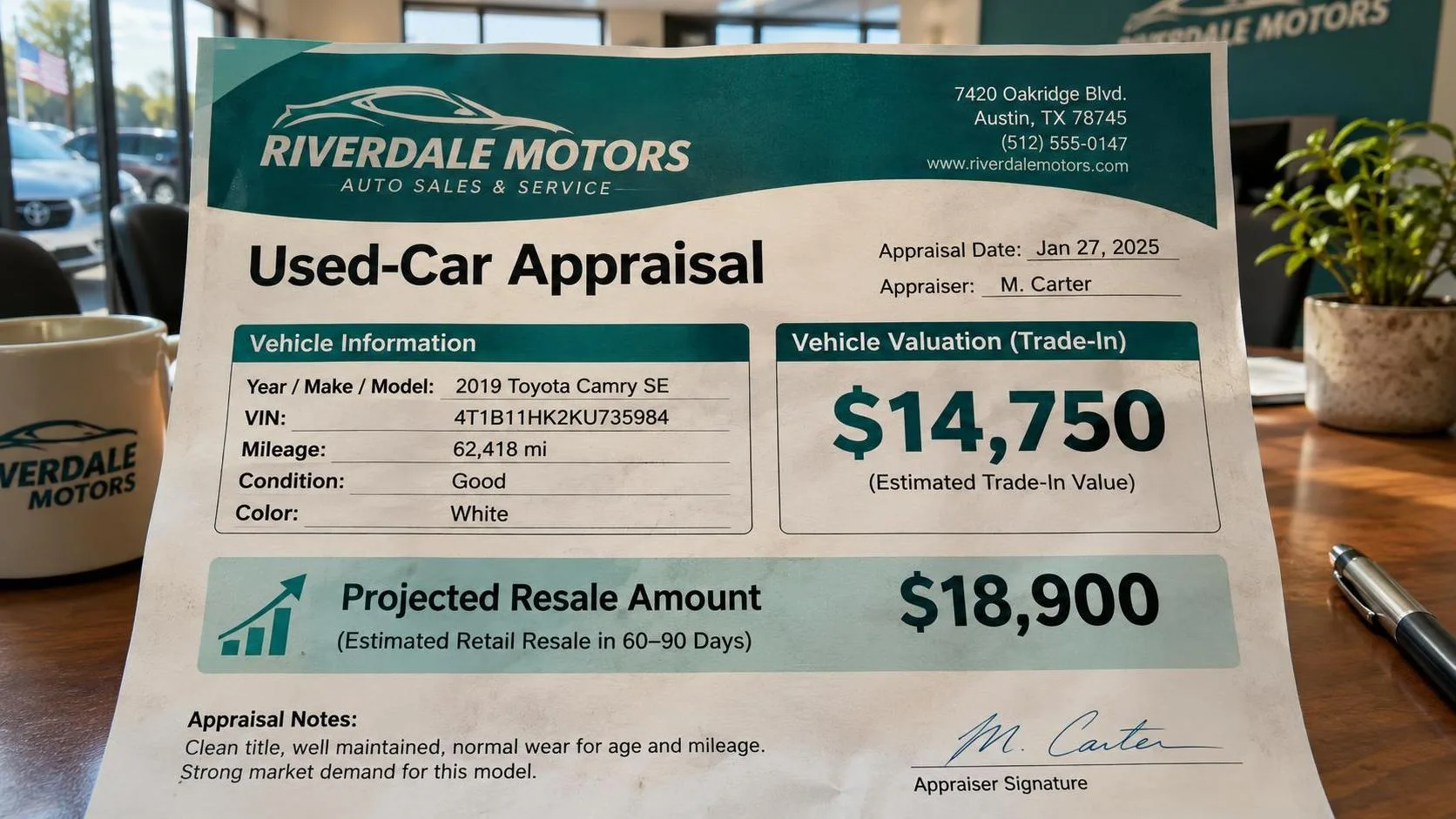
Residual value is not an accounting footnote. It is the amount a vehicle should be worth when you sell, trade, or remove it from service, and it directly affects cost per mile, replacement timing, and capital planning. In a 400-unit fleet, a $2,000 forecasting error across 100 annual disposals creates a $200,000 budget swing before auction fees, repairs, or taxes. The practical question is simple: what it costs, what it pays back, and what it triggers with DOT.
Why residual value matters in fleet replacement
A truck purchased for $72,000 and sold for $38,000 after five years has a $34,000 depreciation cost before financing, maintenance, and fuel. If that unit travels 100,000 miles, depreciation alone is 34 cents per mile. A comparable truck sold for $30,000 produces 42 cents per mile. That eight-cent difference equals $8,000 over 100,000 miles, which is enough to change a replacement recommendation.
Residual value also affects lease-versus-buy decisions. A finance company builds an expected end-of-term value into the payment. If the forecast is too optimistic, the lease payment can look attractive while the actual market result leaves an unpleasant settlement or disposal gap. If the forecast is too conservative, the monthly cost may be higher than necessary. I want the finance team, maintenance team, and remarketing team working from the same assumptions.
For trucks, the estimate should include mileage, engine hours, axle configuration, body type, service records, tire condition, accident history, and regional demand. A refrigerated box truck does not follow the same curve as a dry van, even when both use the same chassis.
What changes residual value over time
Mileage is visible, but it is not the only driver. A well-maintained medium-duty truck with 180,000 highway miles can bring more than a neglected truck with 130,000 stop-and-go miles. Engine hours, idle time, payload, road salt, and loading practices tell the buyer how hard the asset worked.
Maintenance documentation is a financial asset. Work orders showing preventive service, fluid analysis, brake replacement, tire rotations, and recall completion give a buyer confidence. Missing records create uncertainty, and uncertainty becomes a discount. From our fleet’s data, a clean service history also shortens the time a unit sits in the yard waiting for a buyer because the auction or dealer can describe it accurately.
Configuration matters just as much. A common wheelbase, standard transmission, popular body length, and widely available parts generally improve the buyer pool. An unusual vocational setup can be valuable to one buyer but difficult to place. Before ordering a batch of vehicles, ask the remarketing team who will want those units in five years.
How to forecast residual value with useful numbers
Start with three sources: recent internal disposals, current wholesale and retail listings, and an independent valuation guide. Do not copy a retail asking price into a capital plan. Retail prices include preparation, warranty expectations, dealer overhead, and negotiation room. Wholesale results are usually closer to the fleet’s likely outcome, but auction condition and lane location still matter.
Build a low, expected, and high case. For example, a van bought for $54,000 might be projected at $24,000 in the expected case after four years and 90,000 miles. A conservative case could use $20,000, while a strong market case could use $27,000. The spread is not a prediction; it is a planning range that lets the CFO see how sensitive the replacement plan is.
Track the result by vehicle class and duty cycle. Compare forecasted proceeds with actual net proceeds after transport, inspection, detailing, auction commission, title work, and repairs. A truck selling for $35,000 at auction may generate only $31,500 after disposal costs. That net figure is what belongs in your cost-per-mile model.
Residual value and commercial auto insurance
Insurance does not guarantee residual value. Commercial physical damage coverage typically responds to covered loss based on the vehicle’s actual cash value, less the deductible, subject to the policy terms and limits. Actual cash value is a claims valuation concept; it is not automatically the same as your depreciation schedule or your planned sale price.
That distinction matters after a total loss. If your books show a truck at $42,000 but the insurer values it at $34,000, the accounting number does not create an $8,000 insurance payment. A loan or lease can also leave a balance above the settlement amount. Gap protection, when available and appropriate, addresses that type of shortfall rather than improving the truck’s market price.
Review physical damage limits whenever replacement costs or used-equipment prices move sharply. For owned units, compare the premium and deductible with the realistic exposure. For leased equipment, confirm who carries coverage, how loss settlement is calculated, and whether the contract requires a specific deductible. Keep titles, purchase invoices, equipment specifications, and maintenance records accessible after a claim.

A replacement workflow that protects the number
Set the target disposal point before the truck reaches it. At 12 months out, review mileage, utilization, repair history, tire condition, and current market listings. At nine months, decide whether to correct cosmetic damage, complete deferred maintenance, or stop spending on nonessential improvements. At six months, confirm whether the unit will be sold, transferred, or retained as a reserve.
Use a repair threshold based on expected proceeds. Spending $4,000 to gain $7,000 in sale price can make sense, but spending $4,000 to gain $2,500 does not. Cosmetic work should be evaluated separately from safety and compliance work. Brakes, lighting, tires, and required repairs are not optional investments simply because the truck is near disposal.
Document the decision. Record the projected sale price, repair estimate, expected downtime, transport cost, and final net proceeds. This creates an audit trail for procurement and gives the next replacement cycle better data. It also prevents the common mistake of blaming the auction when the real problem was an unrealistic forecast.
Electric vehicles and residual value risk
Electric commercial vehicles add another layer to the estimate. Battery health, remaining warranty, charging compatibility, software support, payload impact, and buyer familiarity can all influence the market. A fleet should not assume that today’s high demand or incentives will remain in place when the first batch reaches disposal.
For an electric pilot, track battery state-of-health reports, energy cost per mile, charging downtime, tire wear, and route suitability alongside resale observations. If there is no reliable secondary market, use a more conservative planning case and calculate the cost of holding the vehicle longer. A two-year extension can improve depreciation per mile, but only if uptime and maintenance costs remain acceptable.
The right answer is not always the highest sale price. A unit that produces reliable service at a predictable cost can beat a newer vehicle with a better forecast but poor route fit. Measure utilization, downtime, and disposal proceeds together.
The CFO-ready summary
When I present residual value, I lead with three numbers: expected net sale proceeds, depreciation cost per mile, and the downside case. Then I show the assumptions behind mileage, duty cycle, maintenance condition, and market timing. That conversation is more useful than arguing over a single optimistic resale estimate.
Use the same framework for tractors, straight trucks, vans, trailers, and electric units. Reconcile forecasts with actual sales every quarter, update insurance schedules when vehicle values change, and involve maintenance before approving disposal repairs. Good fleet management is not about predicting the market perfectly. It is about recognizing exposure early enough to act.
Residual value rewards disciplined specifications, complete records, sensible replacement timing, and honest insurance planning. Get those four pieces aligned, and the fleet produces fewer budget surprises while keeping uptime and compliance on the same page.