
A fleet management system should do more than draw vehicle dots on a map. For a 20-vehicle service operation or a 5,000-truck carrier, the right platform lowers cost per mile, protects uptime, and gives your safety team records it can produce during a DOT review. I have spent two decades working through dispatch, maintenance, vehicle specification, and compliance. The useful question is simple: what will this fleet management system change on Monday morning, and when will the savings pay for it?
Start with the numbers your CFO will ask about
Three numbers deserve attention before a sales demonstration: annual downtime hours, controllable fuel expense, and preventable incident cost. If 100 vehicles each lose six hours monthly to avoidable scheduling or repair delays, that is 7,200 hours of lost availability each year. Put a loaded labor and revenue value of $45 per hour against it and the exposure reaches $324,000. Your number will differ, but the method is sound.
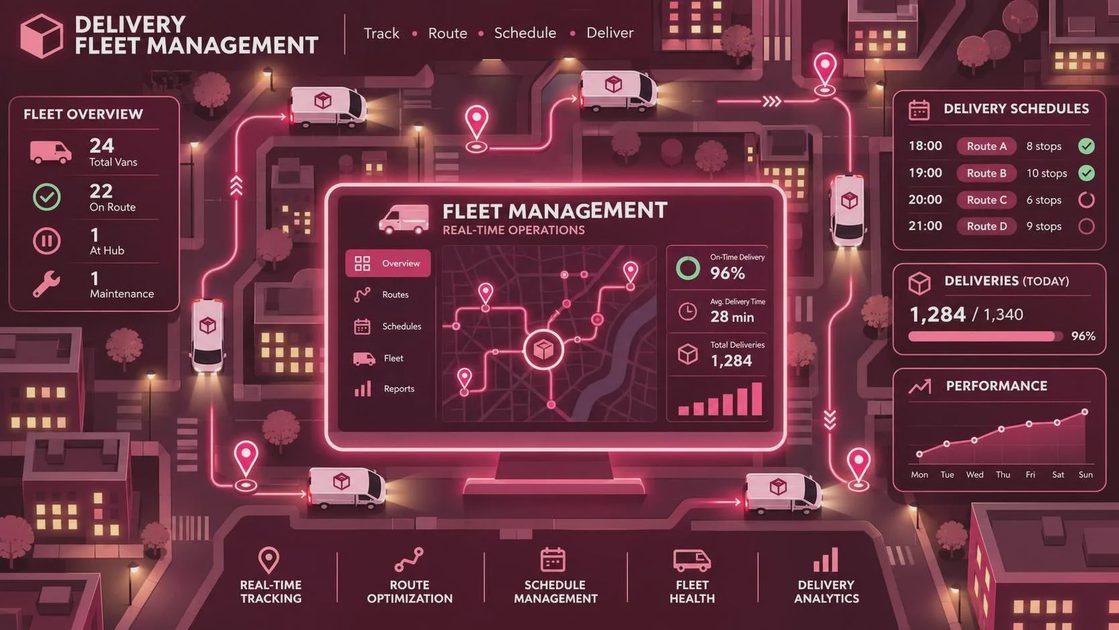
A fleet management system can connect work orders, inspection results, odometer readings, GPS history, fuel transactions, and driver behavior in one operating picture. That connection matters because a dispatcher sees a late truck, while a maintenance manager sees an overdue service event. Separate spreadsheets hide the relationship. A unified platform can show whether the late truck has excessive idle time, repeated fault codes, or a route assignment that exceeds its useful range.
Fleet Impact: If software costs $20 to $45 per vehicle monthly, a 100-unit operation might spend $24,000 to $54,000 annually before installation and hardware. Recovering two or three preventable roadside events, or reducing fuel waste by a measurable amount, can create a defensible payback case. Do not promise savings before establishing your baseline.

Which capabilities actually matter
The best fleet management system is not the one with the longest feature list. It is the one your supervisors use consistently and your data can support. Start with live location and geofencing, but do not stop there. Location is useful for customer communication, unauthorized movement alerts, and route review. It does not by itself improve utilization or prevent a failed alternator.
Maintenance workflow is usually where operational value becomes tangible. Look for preventive service triggers based on mileage, engine hours, calendar dates, and manufacturer intervals. The system should assign work, capture parts and labor, document approval, and show whether a vehicle returned to service. Fault-code integration can help maintenance staff prioritize a warning that threatens drivability over one that can be scheduled during the next shop visit.
For safety, evaluate harsh-braking events, speeding thresholds, seat-belt reporting, camera integration, and coaching records. Avoid treating every alert as a disciplinary event. Dallas traffic can create a hard-braking alert that tells you little; a repeated pattern at the same intersection deserves a route or training review. Configure thresholds with your safety manager, document the policy, and apply it consistently.
A fleet management system should also support electronic records without pretending to replace legal judgment. Hours-of-service requirements under 49 CFR Part 395, inspection obligations under 49 CFR Part 396, and driver qualification responsibilities still require management oversight. Electronic logging devices must meet applicable FMCSA requirements. Software can organize records and surface exceptions, but a manager remains responsible for correcting errors and retaining required documentation.
Building an ROI case without inflated promises
Use a 90-day baseline before changing targets. Record fuel gallons per mile, idle hours, maintenance cost per mile, tire replacement frequency, preventable crashes, roadside events, and vehicle utilization. Separate fixed costs from variable costs. A vehicle that sits unused is not automatically cheap; depreciation, insurance, registration, and financing continue while revenue opportunity disappears.
Then select one measurable intervention. For example, a fleet management system might identify 18 vehicles idling more than 40 minutes per shift. If each vehicle burns roughly 0.8 gallons per idle hour and fuel costs $3.75 per gallon, cutting 30 minutes daily over 250 workdays saves about 1,500 gallons, or $5,625, before considering engine wear. That is an illustration, not a promised result. Your engine type, weather, PTO use, and route schedule must be included in the calculation.
The same approach works for maintenance. If a 200-unit fleet experiences 30 roadside failures annually at a combined average cost of $1,200 each, preventing five events saves $6,000. Add towing, missed delivery penalties, replacement vehicles, and customer recovery labor when those costs are documented. A credible business case shows assumptions, not just a large projected percentage.
Implementation is where many platforms fail
Assign one operational owner before signing. That person should control configuration, user permissions, data definitions, and the escalation process. Involve dispatch, maintenance, safety, payroll, and drivers during a pilot. A system that satisfies IT but adds six clicks to a pre-trip inspection will be bypassed in the yard.
Clean your fleet file first. Confirm unit numbers, VINs, license plates, trailer relationships, odometer readings, driver assignments, service intervals, and fuel-card identifiers. Duplicate units can corrupt utilization reports. Incorrect odometers can trigger early service reminders or, worse, miss a required inspection. Test the data with five to ten vehicles representing different makes, duty cycles, and telematics hardware.
Train by workflow rather than by menu. Show a dispatcher how to verify an arrival, a technician how to close a work order, and a safety manager how to document coaching. Set a 30-day review for alert volume, user logins, missing inspections, and inaccurate vehicle status. If the system generates 500 alerts daily and nobody can act on them, reduce the noise before drivers decide every alert is meaningless.
Procurement questions that expose weak fits
Ask vendors to demonstrate your process using your terminology. Can the fleet management system show a vehicle's last inspection, open defect, current assignment, fuel history, and maintenance cost without exporting five reports? Can it distinguish personal use from route work? Can it export records in a usable format if you change providers? What happens when a device loses cellular coverage? How are data corrections logged?
Request pricing for hardware, installation, cellular service, software, implementation, training, support, replacement devices, and early termination. Some offers appear inexpensive until installation and data fees are added. Ask for uptime commitments, support response targets, security controls, and data ownership language. Obtain references from fleets with similar vehicle classes and regulatory obligations, not just a larger company with a dedicated analytics department.
Review driver privacy and labor implications before deployment. Explain what is tracked, when it is tracked, how long records are retained, and who can access them. A written policy should address off-duty use, camera footage, disciplinary review, and data corrections. Clear rules reduce resistance and give supervisors a consistent standard.
The operating rhythm after launch
A fleet management system becomes valuable through weekly management habits, not installation day. Review exceptions every Monday: overdue preventive maintenance, unassigned defects, excessive idle time, speeding trends, unauthorized movement, and vehicles with low utilization. Assign an owner and due date for each exception. Review cost per mile monthly and compare vehicles doing similar work rather than ranking a short-haul van against a highway tractor.
After 90 days, retire reports nobody uses and add only the measures tied to a decision. From our fleet's data, a short list is more useful than a dashboard crowded with colorful gauges: availability, maintenance cost per mile, fuel consumption, preventable incidents, utilization, and compliance exceptions. Those six measures tell you what it costs, what it pays back, and what it triggers with DOT.
The purchase decision should follow the operation, not the demo. Define the problem, establish the baseline, pilot with representative vehicles, and calculate savings from observed changes. A fleet management system cannot fix weak preventive-maintenance discipline or an unclear driver policy by itself. It can make those gaps visible, assign accountability, and give a manager enough reliable information to act before a missed service interval becomes a roadside failure.