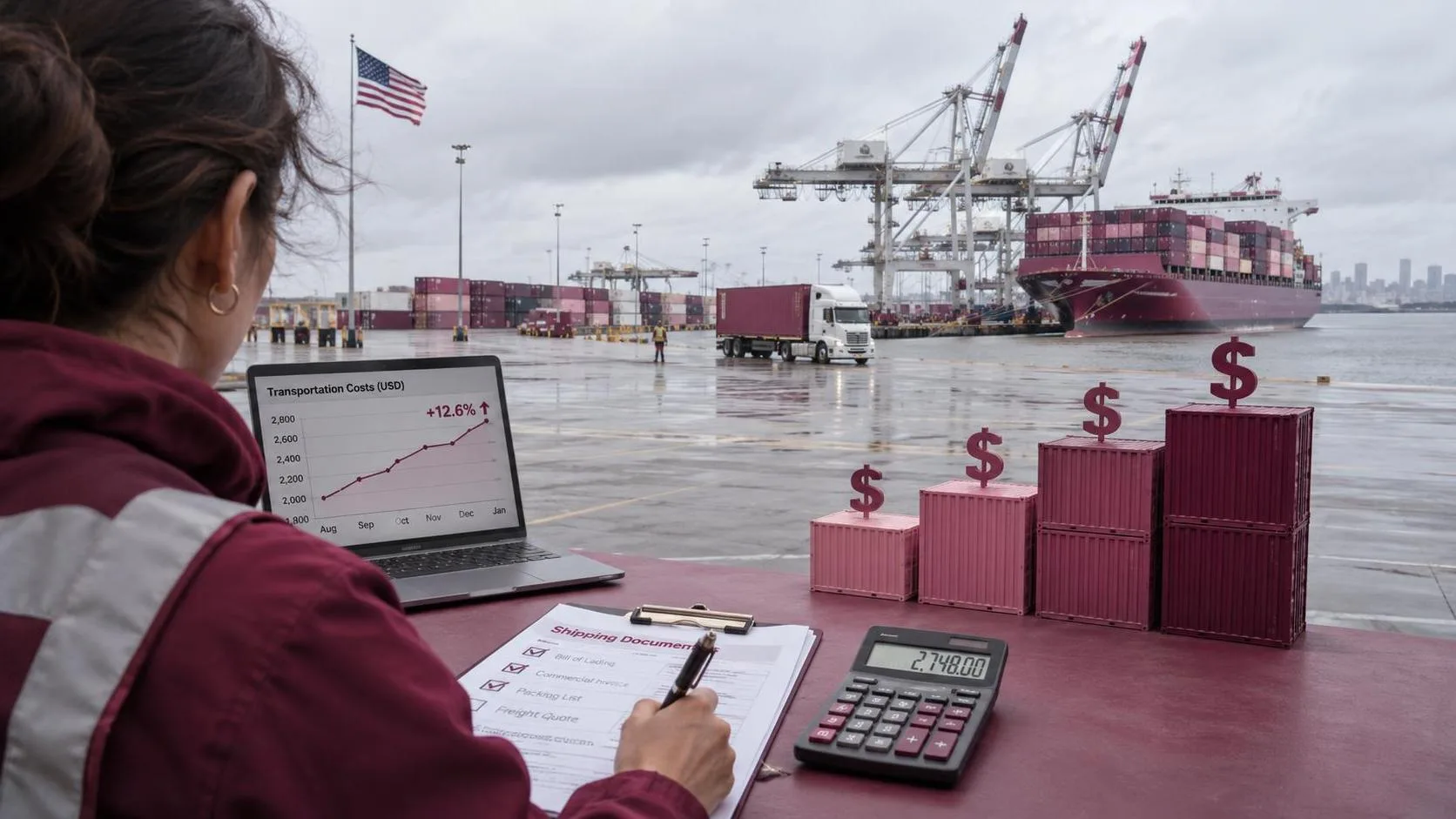
A load paying $2.50 per loaded mile can lose money if the truck drives too far empty or sits at the dock without compensation. To evaluate freight rates, divide the full payment by all miles required to cover the load, then compare that revenue with your fully allocated cost per mile. Three numbers your CFO will ask about are total revenue, total miles, and contribution after operating costs.
For transportation buyers, the same discipline works in reverse: compare the complete landed transportation charge, not just the quoted linehaul. Fuel, detention, extra stops, and service failures can turn the cheapest bid into the most expensive lane.
How freight rates are quoted
Truckload freight rates are commonly expressed as a flat charge per load or a rate per loaded mile. Less-than-truckload pricing may incorporate shipment weight, freight classification, dimensions, and accessorial charges. Contract terms and carrier tariffs determine how those pieces are applied.
A spot quote generally covers an individual shipment at an agreed price. A contract rate typically covers an agreed lane or service over a defined period, subject to its terms. Neither guarantees capacity or a particular service level unless the agreement says so. Check tender acceptance expectations, volume commitments, and what happens when the carrier cannot cover a load.
Fuel can be included in the linehaul or listed as a separate surcharge. Ask which price index, baseline, mileage basis, and adjustment schedule apply. Two quotes with the same base rate may produce different invoices when fuel moves. Also confirm whether the quoted mileage comes from actual miles, a routing guide, or another agreed calculation.
Calculate revenue per total mile
Here is an illustrative truckload: a carrier receives $2,500 in linehaul and $300 in fuel surcharge for 1,000 loaded miles. The truck also drives 150 unpaid miles to pickup. Assuming no other payment, the $2,800 total divided by 1,150 miles equals about $2.43 per total mile, not $2.80.
If the carrier's fully allocated operating cost is $2.20 per total mile for this example, 1,150 miles cost $2,530. The load contributes $270 after those allocated costs, before any costs or taxes not included in that figure. Treat the $2.20 as an example, not a market benchmark; your fleet's costs and accounting treatment will differ.
Fleet Impact: Removing 50 unpaid miles from that same load would reduce estimated operating cost by $110 at $2.20 per mile, assuming the cost changes proportionately. In practice, separate variable savings from fixed costs that will remain. A shorter reposition may also free driver hours, but that benefit depends on the actual schedule.
Include driver compensation, fuel, maintenance, tires, insurance, permits, equipment ownership or lease expense, and overhead in the cost model. Use actual lane experience where possible. A refrigerated load, a stop-heavy route, and a straight highway run can have very different cost structures even with identical mileage.
Account for time and accessorials
Freight rates based only on miles miss a truck's scarcest resource: available working time. A delivery that consumes an extra half-day may prevent the next load from being covered. Compare revenue and contribution per truck-day as well as per mile, particularly on short hauls and multi-stop routes.
Put accessorial terms in writing before dispatch. Detention should specify the free time, when the clock starts, the hourly charge, and required arrival and departure documentation. Layover, truck ordered but not used, extra stops, driver assist, and reconsignment deserve the same treatment where relevant. An accessorial is not revenue until the contract permits it and the customer accepts the supporting records.
For buyers, a low quote with vague accessorial language is not a clean comparison. Give each bidder the same appointment windows, loading expectations, stop count, equipment needs, and shipment dimensions. Then compare the base charge and realistic extras separately. That makes a carrier's price easier to audit without pretending every shipment will move perfectly.

For carriers, track detention requested, approved, and actually paid. The difference identifies customers or facilities where a nominally attractive lane consumes capacity without paying for it. Use time stamps and signed documents where the agreement requires them; a dispatch note alone may not satisfy the billing terms.
Compare freight rates by lane, not by headline
There is no single useful national rate for every move. Equipment type, origin, destination, seasonality, lead time, weight, service requirements, and the likelihood of a paying return load all affect an individual quote. Market indexes can provide context, but check whether their figures include fuel and whether their lane and equipment definitions match your shipment.
Build a lane scorecard using your own completed loads. Record quoted and invoiced charges, loaded and empty miles, pickup and delivery delays, tender acceptance, and service failures. Review enough history to understand recurring patterns, then separate unusual disruptions from normal operating conditions. A cheap outbound lane may be worthwhile with a dependable paid backhaul; it may be a poor deal when the truck routinely returns empty.
When negotiating freight rates, show the other party the operational reason for a proposed change. A wider appointment window, drop-and-hook arrangement, or more consistent tender volume may reduce cost without simply shifting risk from one side to the other. Put the assumptions in the agreement and revisit the price if those assumptions change.
Protect the margin without creating a compliance problem
A rate calculation does not override hours-of-service rules. For property-carrying drivers subject to the federal limits, 49 CFR 395.3 includes an 11-hour driving limit after 10 consecutive hours off duty and a 14-hour driving window, subject to applicable exceptions. Build the actual route and appointment plan around the rules that apply to the driver and operation, not around an optimistic mileage target.
Fleet Impact: A higher-paying load is not a gain if covering it requires an unlawful schedule or leaves no practical time for required inspections. Check driver availability, equipment readiness, and appointment times before accepting. The applicable pre-trip and driver vehicle inspection requirements are addressed in 49 CFR 396.13 and 396.11.
What it costs, what it pays back, what it triggers with DOT: use those three checks before approving the lane. Start with the next ten completed loads, reconcile their invoices and total miles, and flag the ones whose time or empty mileage erased the apparent margin. That gives both operations and purchasing a defensible starting point for the next negotiation.